When The Space You Grew Up In Never Lets You Go
We Never Stop Living in the First Space That Loved Us
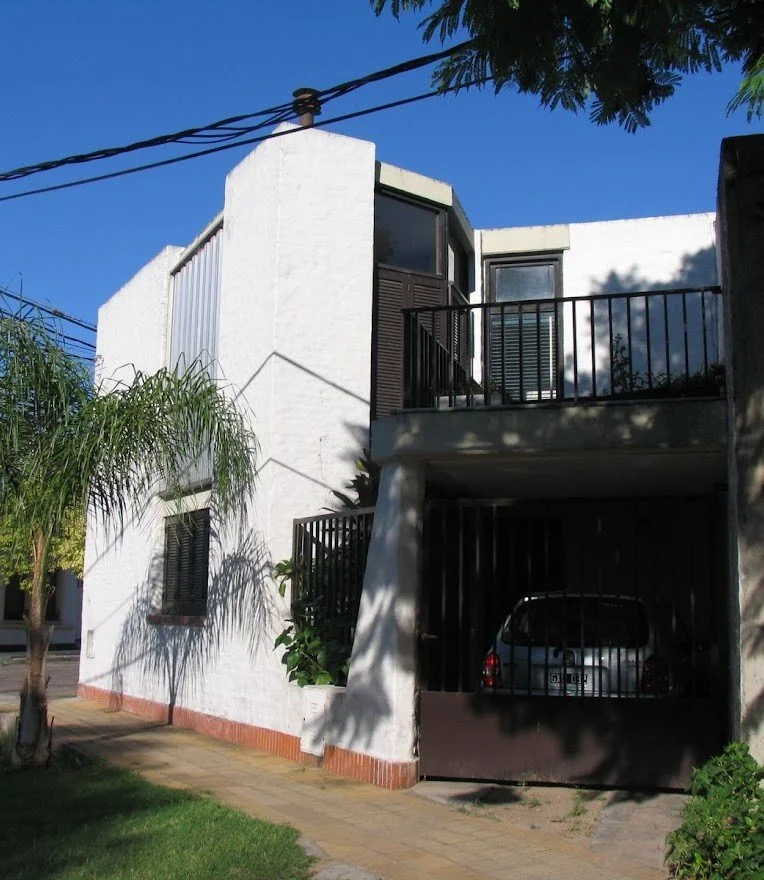
Eduardo Villaverde- Argentina Architecture - Casablanquismo- 1967
To the house my father built. A great architect. And a patrimonial piece of a city that may not know its architectural value.
I am about to lose the house that defined how I perceive architecture. Some spaces stay with us forever. And some, simply, disappear.
Some spaces are unforgettable.
Many of us can remember the spaces where we grew up. Not only houses. The school with the courtyard that smelled like rain. The street corner where afternoon light fell in a particular way. The town square that felt like the center of the world. The classroom where ceilings were high enough to let your mind wander.
We don't just remember these spaces. We carry them within us.
In childhood, the perception of space is not intellectual. It is entirely sensory. We learn through touch, through smell, through light, through temperature, through how our bodies move and inhabit a place. Everything happens with an intensity that rarely repeats.
And it is precisely there that something fundamental is built: the way we will understand space for the rest of our lives.
In my case, that way of perceiving has a very clear origin: the house where I grew up.
It was designed by my father, an architect, during a time when he was deeply influenced by international currents. In his studio, publications like Architectural Record and L'Architecture d'Aujourd'hui sat alongside books on Le Corbusier or Frank Lloyd Wright.
But beyond references, what he built was something entirely his own.
A house that followed a then-vanguardist trend: Casablanquismo. Pure geometry, white planes, tall vertical windows, spaces connected through levels and double heights. It was the second house of this movement ever built in that city. A patrimonial imprint of an architectural moment in Argentina. A piece of history that happens to be where I grew up.
There was no luxury in furniture or decoration. The luxury was in proportion, in light, in circulation, in the feeling of fully inhabiting each space. The luxury was experiencing the space.
The living room, dining area, and kitchen flowed together in a dynamic continuity. A wooden mezzanine housed my father's architectural studio, suspended above family life.
We grew up, four siblings, in a space where life and architecture coexisted.
While he met clients and explained projects, we played downstairs or retreated to our rooms. We listened to architecture without knowing it. We lived it.
And most importantly: our way of perceiving space was being formed there.
Through the touch of materials. Through light shaping the rooms. Through differences in height. Through thermal sensations. Through how space could be open, fluid, or contained.
This way of perceiving is not learned later. It is formed in those first years. And it stays with us for life.
It is not just emotional memory. It is a structure of perception.
Everyone who entered that house reacted the same: "How beautiful." "How different." "What a way to live."
It wasn't ostentatious. It was magnetic.
It showed that architecture is not a sum of modular square meters. That space can be thought through, stretched, enriched, transformed until it becomes an experience.
For me, it has always been, and still is, a work of true architectural value. One of those buildings that should be considered heritage. Not out of nostalgia, but because of what it represents: a way of thinking about space that marked an era.
Today, however, that house is about to disappear.
Without my parents, I cannot maintain it. I live abroad. The repairs it needs are beyond what I can carry financially. The maintenance, the costs, the distance , together, they make it impossible.
I want to save it. I have tried to find a way. But I cannot.
And it will most likely be sold. And possibly demolished.
It is hard to accept that a house like this, the few firsts of its kind built in the country, a living document of Argentine architectural history, can simply vanish.
But this is not an isolated case.
Recently, an architect friend experienced something very similar. The house she grew up in, a historic home with vast rooms, high ceilings, and a a big garden, had been a gathering place for friends. The house was demolished, unleashing a powerful wave
of spatial memories within her and stirring deep emotions throughout her childtheir house was a gathering place for the friends, was demolished, causing a strong storm of spatial memories on her.
It made me realize that this goes beyond a personal story.
The spaces we grow up in are more than buildings. More than addresses.
They teach us, without words, how to perceive space. They define our relationship with architecture. They explain, in many cases, why we do what we do.
And I think this goes even further.
Those first spaces do not only explain the past. They shape the future.
The proportions we experienced as children become a silent standard. We carry them into every decision we make about space later in life. The apartment we choose. The home we dream of. The projects we design.
We tell ourselves we are being rational. Square meters. Location. Budget. But underneath, something older is at work.
A quality of light we recognized before we had words for it. A ceiling height that feels right without explanation. A threshold that opens onto something generous.
We are always, in some way, looking for that first space again. Or building it.
Life adds layers, of course. Every new city we inhabit marks us. Every building that moves us expands our vocabulary. Travel opens us to other ways of living, other scales, other relationships between inside and outside. Studies give us frameworks. Other cultures give us perspective.
But the original imprint remains. Quiet. Persistent. Remarkably intact.
It is not nostalgia. It is perception. Formed early. Carried always.
Perhaps that is why I write this today. As a reflection, but also as a farewell.
I may not be able to save that house. But I can continue defending the way of understanding architecture that was born there.
The way of understanding space , where true luxury is not material, but experience , is the one I continue to champion in every project.
And perhaps that is the most important thing we can do as architects and designers:
Be conscious that the spaces we design and build today are forming someone's first perception. Their future longing. Their way of seeing space for the rest of their life